Buy bild24.eu ?
We are moving the project
bild24.eu .
Are you interested in purchasing the domain
bild24.eu ?
domain@kv-gmbh.de · 0541-91531010
Buy bild24.eu ?
Is general relativity compatible with quantum mechanics?
General relativity and quantum mechanics are currently not fully compatible with each other. General relativity describes the force of gravity on a large scale, while quantum mechanics deals with the behavior of particles on a very small scale. Efforts to unify these two theories into a single framework, known as quantum gravity, have not yet been successful. Many physicists believe that a successful theory of quantum gravity will be needed to fully understand the behavior of the universe at all scales. **
What is the general theory of relativity?
The general theory of relativity, proposed by Albert Einstein in 1915, is a fundamental theory in physics that describes the force of gravity as a curvature of spacetime caused by the presence of mass and energy. According to this theory, massive objects like planets and stars warp the fabric of spacetime, causing other objects to move along curved paths. General relativity has been confirmed through numerous experimental tests and is the basis for our current understanding of gravity and the structure of the universe. **

Similar search terms for General relativity
Top-Angebote
Products related to General relativity:
-
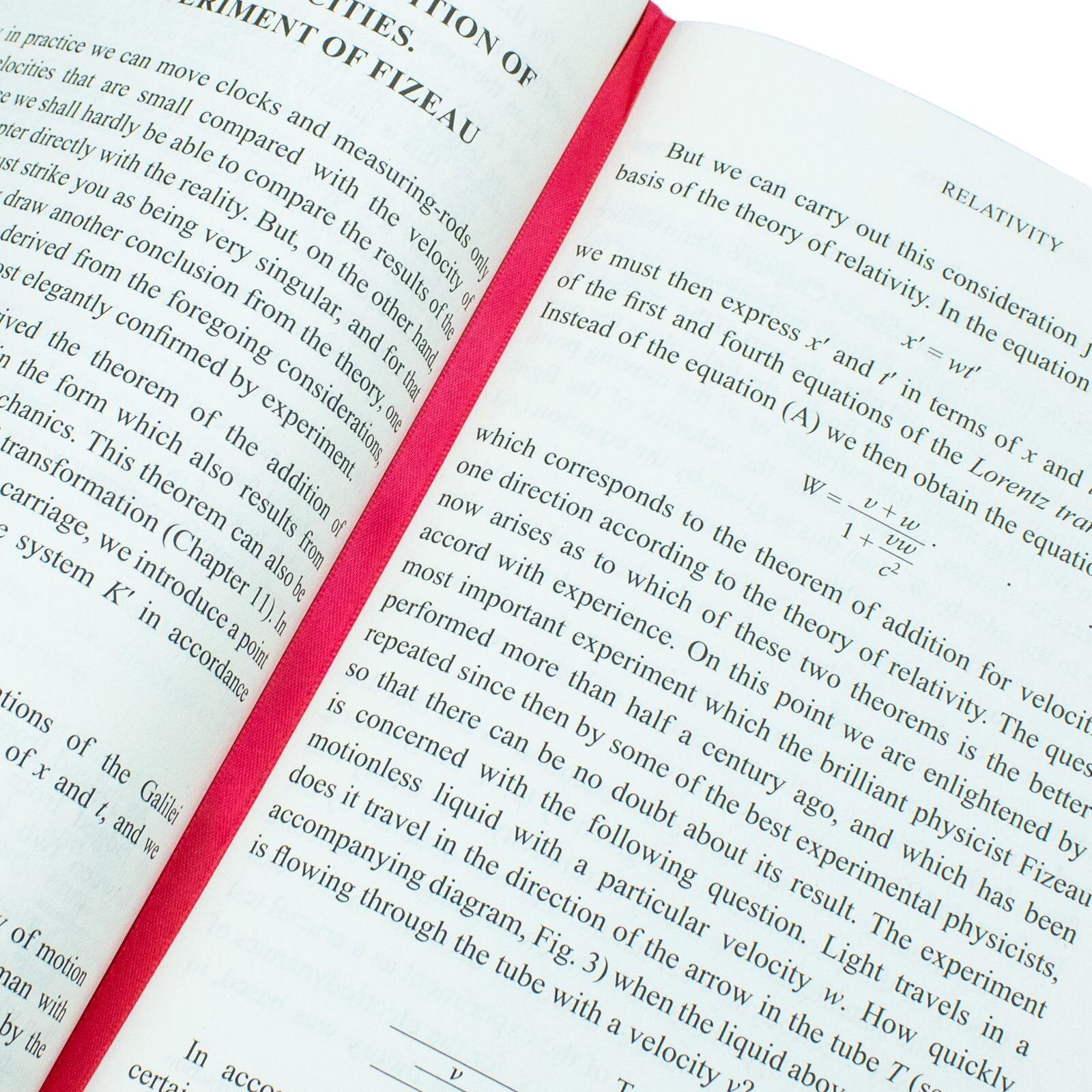
Relativity By Albert Einstein - Non Fiction Reference Edition - HardcoverTitle:. Relativity by Albert Einstein Condition: BRAND NEW. Format: Hardcover. ISBN: 9789376461844 Overview:. You can explore modern physics with this pristine hardcover edition. Albert Einstein authored this essential volume for the everyday reader. He intentionally removed complex math equations. The result is a thrilling and deeply insightful narrative. You step directly into the mind of history’s greatest physicist. He completely transformed our understanding of space and time. This reference edition brings his ground-breaking theories to life. You will watch him turn complex topics into fascinating discussions. The prose remains accessible throughout the entire book. You do not need advanced training to follow his logic. The author guides you smoothly toward major conclusions. You learn how stars bend light and how time moves differently depending on speed. This practical guide serves as a perfect bridge to theoretical physics. It strips away intimidating academic language. You simply gain a fresh perspective on how the universe works. Einstein makes profound scientific truths feel like natural discoveries. This edition invites you to rethink reality itself. What Makes This Book Stand Out:. This edition preserves the original scientific voice beautifully. Modern textbooks often overwhelm readers with heavy jargon. They force you to struggle through dense calculations first. Einstein deliberately avoided those serious roadblocks in this volume. He focused strictly on the core conceptual leaps. You watch him build an entire theory from simple observations. He compares train journeys to light beams effortlessly. The writing style feels like a private conversation with genius. You benefit from decades of careful research distilled into clear statements. The hardcover binding adds lasting durability to the pages. Your copies will withstand frequent reference checks. The layout prioritizes readability over decorative clutter. You receive a reliable physical reference for future study. The publisher chose a sturdy format that respects the text. Your hands stay clean while flipping through chapters. This specific release captures the elegance of pure science. It proves that complex ideas do not require massive volumes. You get maximum insight with minimal friction. Who This Book Is Perfect For:. Readers looking for stimulating non-fiction will love this book. Students often seek resources that explain physics without boring lectures. You will find plenty of value in this balanced approach. Professionals in engineering and astronomy may keep it handy for quick refreshers. Educators frequently suggest it to students starting their journey. Parents searching for thoughtful gifts should consider this selection. Scientists and hobbyists both appreciate the direct delivery of information. You will enjoy this if you prefer learning through stories. Curious minds who dislike dry academic texts will thrive here. Collectors of classic scientific works often...5,99 £*Shipping: 2,99 £Secure redirect to the provider
-
Icon Books Introducing Relativity: A Graphic Guide - Non Fiction - PaperbackTitle:. Introducing Relativity: A Graphic Guide Format: Paperback Overview:. Uncover the mysteries of space, time, and gravity without reaching for a calculus textbook. *Introducing Relativity: A Graphic Guide* transforms Albert Einstein's mind-bending theories into an accessible, entertaining, and visually stunning journey. Part of the renowned 'Introducing' series, this graphic guide bridges the gap between complex theoretical physics and everyday curiosity, offering a unique reading experience for anyone who has ever looked up at the stars and wondered how the universe truly works. Published by Icon Books, widely recognised for their best-selling iconographic guides, this release continues a lineage of titles that have educated millions of readers worldwide. The book demystifies both Special and General Relativity, exploring concepts such as time dilation, length contraction, the constancy of the speed of light, and the warping of spacetime caused by massive objects. The layout encourages linear progression while allowing for dipping in and out, making it a flexible study tool for self-learners. Whether you are trying to grasp the basics of modern physics for the first time or refreshing your knowledge of Einstein's legacy, this guide delivers deep understanding wrapped in a format that is genuinely enjoyable to read. Furthermore, the enduring relevance of relativity in fields ranging from GPS navigation to gravitational wave detection underscores why understanding these principles matters in the modern world, giving this guide practical context beyond pure theory and positioning it as an essential addition to any science enthusiast's library. What Makes This Book Stand Out:. Unlike traditional science texts that can feel dense and unforgiving, *Introducing Relativity* leverages the power of sequential art to build intuition before introducing formal concepts. The pairing of M.J.B. Light's precise scientific explanation with Tom Gauld's witty, deadpan artwork creates a tone that is both informative and delightfully funny. This combination helps readers retain information far more effectively than standard prose alone, as the visuals anchor abstract ideas in memorable scenes. Readers are guided through Einstein's famous thought experiments, such as chasing a beam of light or riding a falling elevator, bringing abstract mental models to life through dynamic panels. This method connects historical context with conceptual breakthroughs, helping the audience appreciate the human process of scientific revolution rather than just memorising outcomes. The graphic style does not dilute the science; instead, it clarifies it. Complex phenomena like parallel universes, black hole event horizons, and the equivalence principle are broken down into digestible chunks supported by diagrams and gags that illustrate the physical reality behind the equations. For students encountering physics for the first time, this book offers a less intimidating entry point,...8,99 £*Shipping: 2,99 £Secure redirect to the provider
-
Inspired Finds Leopard Print General Motors Headrest Covers Stylish 2PCS Car Seat Protectors Leopard Print General Motors Headrest Covers Stylish 2PCS Car Seat ProtectorsTransform your vehicle interior with these bold and fashionable headrest covers designed to add personality, comfort, and stylish protection to your seats. Featuring a vibrant leopard print design, these covers instantly refresh your cabin with a...34,99 $*Shipping: 0,00 $Secure redirect to the provider
-
Tools, Home & Hobby 2HP Electric Motor 1725 RPM Single Phase 56C Frame General Purpose Motor 2HP Electric Motor 1725 RPM Single Phase 56C Frame General Purpose MotorKeep your equipment running with dependable power built for demanding everyday jobs. This 2HP electric motor delivers 1725 RPM performance with dual 115V230V operation for flexible installations. Its single phase motor design and 56C frame make it...469,97 $*Shipping: 0,00 $Secure redirect to the provider


-
What is spacetime curvature in general relativity theory?
In general relativity theory, spacetime curvature refers to the bending or warping of the fabric of spacetime caused by the presence of mass and energy. According to Einstein's theory, massive objects such as stars and planets create a gravitational field that curves the surrounding spacetime, causing other objects to move along curved paths. This curvature of spacetime is what we experience as the force of gravity. The more massive an object, the greater the curvature it creates in spacetime, and the stronger its gravitational pull. This concept of spacetime curvature is fundamental to understanding the behavior of gravity in the universe. **
-
What is the principle of energy conservation in general relativity theory?
The principle of energy conservation in general relativity theory states that the total energy of a closed system remains constant over time. This means that energy cannot be created or destroyed, but only transformed from one form to another. In the context of general relativity, this principle is related to the curvature of spacetime and the gravitational interactions between matter and energy. It implies that the gravitational field itself carries energy, and that the total energy of a system includes both the energy associated with matter and the energy associated with the gravitational field. **
-
Do general relativity and quantum mechanics work independently of each other?
General relativity and quantum mechanics are two fundamental theories in physics that describe the behavior of the universe at different scales. While both theories have been incredibly successful in explaining a wide range of phenomena, they are not fully compatible with each other. General relativity describes the force of gravity and the behavior of large-scale objects like planets and galaxies, while quantum mechanics describes the behavior of particles at the smallest scales. Efforts to unify these two theories into a single framework, such as quantum gravity, are ongoing, but as of now, they work independently of each other in their respective domains. **
-
What are the implications for astronomy from the general theory of relativity?
The general theory of relativity has several implications for astronomy. It predicts the existence of black holes, which are regions of space where the gravitational pull is so strong that nothing, not even light, can escape. This has led to the discovery and study of black holes, which has greatly expanded our understanding of the universe. Additionally, the theory predicts the bending of light around massive objects, known as gravitational lensing, which has been used to study distant galaxies and map the distribution of dark matter in the universe. Overall, the general theory of relativity has revolutionized our understanding of the cosmos and continues to shape our exploration of the universe. **


Is that relativity?
Yes, that is relativity. Relativity is a theory developed by Albert Einstein that describes how the laws of physics are the same for all non-accelerating observers and how time and space are intertwined in a concept known as spacetime. It has been confirmed through numerous experiments and observations and has revolutionized our understanding of the universe. **
How did Einstein already predict gravitational waves with his general theory of relativity at that time?
Einstein's general theory of relativity, published in 1915, predicted the existence of gravitational waves as a consequence of his equations describing the curvature of spacetime. According to the theory, massive objects like stars and black holes can create ripples in spacetime as they move, and these ripples manifest as gravitational waves. Einstein's equations also suggested that when two massive objects orbit each other, they would emit gravitational waves, causing a loss of energy and leading to a decrease in their orbit. This prediction was a major breakthrough in our understanding of the nature of gravity and was later confirmed by the detection of gravitational waves in 2015. **
Top-Angebote
Products related to General relativity:
-
Wilco International LLP Relativity: The Special and General by Albert Einstein (Deluxe Hardback Sprayed Edge Edition)Albert Einstein steps away from complex equations to explain, in simple terms, how space bends, time stretches, and gravity connects everything. In Relativity, he encourages readers to reconsider their understanding of motion and time, providing a unique insight into the mind that transformed modern physics with clarity rather than jargon.4,50 £*Shipping: 1,99 £Secure redirect to the provider
-
A-Street Prints Relativity Off White Geometric WallpaperA champagne geometric print shimmers against an off-white background. Subtle silver dots and raised inks add a dimensional effect to its sleek linear pattern. Relativity is an unpasted, non woven wallpaper.124,99 $*Shipping: 0,00 $Secure redirect to the provider
-
Relativity By Albert Einstein - Non Fiction Reference Edition - HardcoverTitle:. Relativity by Albert Einstein Condition: BRAND NEW. Format: Hardcover. ISBN: 9789376461844 Overview:. You can explore modern physics with this pristine hardcover edition. Albert Einstein authored this essential volume for the everyday reader. He intentionally removed complex math equations. The result is a thrilling and deeply insightful narrative. You step directly into the mind of history’s greatest physicist. He completely transformed our understanding of space and time. This reference edition brings his ground-breaking theories to life. You will watch him turn complex topics into fascinating discussions. The prose remains accessible throughout the entire book. You do not need advanced training to follow his logic. The author guides you smoothly toward major conclusions. You learn how stars bend light and how time moves differently depending on speed. This practical guide serves as a perfect bridge to theoretical physics. It strips away intimidating academic language. You simply gain a fresh perspective on how the universe works. Einstein makes profound scientific truths feel like natural discoveries. This edition invites you to rethink reality itself. What Makes This Book Stand Out:. This edition preserves the original scientific voice beautifully. Modern textbooks often overwhelm readers with heavy jargon. They force you to struggle through dense calculations first. Einstein deliberately avoided those serious roadblocks in this volume. He focused strictly on the core conceptual leaps. You watch him build an entire theory from simple observations. He compares train journeys to light beams effortlessly. The writing style feels like a private conversation with genius. You benefit from decades of careful research distilled into clear statements. The hardcover binding adds lasting durability to the pages. Your copies will withstand frequent reference checks. The layout prioritizes readability over decorative clutter. You receive a reliable physical reference for future study. The publisher chose a sturdy format that respects the text. Your hands stay clean while flipping through chapters. This specific release captures the elegance of pure science. It proves that complex ideas do not require massive volumes. You get maximum insight with minimal friction. Who This Book Is Perfect For:. Readers looking for stimulating non-fiction will love this book. Students often seek resources that explain physics without boring lectures. You will find plenty of value in this balanced approach. Professionals in engineering and astronomy may keep it handy for quick refreshers. Educators frequently suggest it to students starting their journey. Parents searching for thoughtful gifts should consider this selection. Scientists and hobbyists both appreciate the direct delivery of information. You will enjoy this if you prefer learning through stories. Curious minds who dislike dry academic texts will thrive here. Collectors of classic scientific works often...5,99 £*Shipping: 2,99 £Secure redirect to the provider
-
Icon Books Introducing Relativity: A Graphic Guide - Non Fiction - PaperbackTitle:. Introducing Relativity: A Graphic Guide Format: Paperback Overview:. Uncover the mysteries of space, time, and gravity without reaching for a calculus textbook. *Introducing Relativity: A Graphic Guide* transforms Albert Einstein's mind-bending theories into an accessible, entertaining, and visually stunning journey. Part of the renowned 'Introducing' series, this graphic guide bridges the gap between complex theoretical physics and everyday curiosity, offering a unique reading experience for anyone who has ever looked up at the stars and wondered how the universe truly works. Published by Icon Books, widely recognised for their best-selling iconographic guides, this release continues a lineage of titles that have educated millions of readers worldwide. The book demystifies both Special and General Relativity, exploring concepts such as time dilation, length contraction, the constancy of the speed of light, and the warping of spacetime caused by massive objects. The layout encourages linear progression while allowing for dipping in and out, making it a flexible study tool for self-learners. Whether you are trying to grasp the basics of modern physics for the first time or refreshing your knowledge of Einstein's legacy, this guide delivers deep understanding wrapped in a format that is genuinely enjoyable to read. Furthermore, the enduring relevance of relativity in fields ranging from GPS navigation to gravitational wave detection underscores why understanding these principles matters in the modern world, giving this guide practical context beyond pure theory and positioning it as an essential addition to any science enthusiast's library. What Makes This Book Stand Out:. Unlike traditional science texts that can feel dense and unforgiving, *Introducing Relativity* leverages the power of sequential art to build intuition before introducing formal concepts. The pairing of M.J.B. Light's precise scientific explanation with Tom Gauld's witty, deadpan artwork creates a tone that is both informative and delightfully funny. This combination helps readers retain information far more effectively than standard prose alone, as the visuals anchor abstract ideas in memorable scenes. Readers are guided through Einstein's famous thought experiments, such as chasing a beam of light or riding a falling elevator, bringing abstract mental models to life through dynamic panels. This method connects historical context with conceptual breakthroughs, helping the audience appreciate the human process of scientific revolution rather than just memorising outcomes. The graphic style does not dilute the science; instead, it clarifies it. Complex phenomena like parallel universes, black hole event horizons, and the equivalence principle are broken down into digestible chunks supported by diagrams and gags that illustrate the physical reality behind the equations. For students encountering physics for the first time, this book offers a less intimidating entry point,...8,99 £*Shipping: 2,99 £Secure redirect to the provider
-
Is general relativity compatible with quantum mechanics?
General relativity and quantum mechanics are currently not fully compatible with each other. General relativity describes the force of gravity on a large scale, while quantum mechanics deals with the behavior of particles on a very small scale. Efforts to unify these two theories into a single framework, known as quantum gravity, have not yet been successful. Many physicists believe that a successful theory of quantum gravity will be needed to fully understand the behavior of the universe at all scales. **
-
What is the general theory of relativity?
The general theory of relativity, proposed by Albert Einstein in 1915, is a fundamental theory in physics that describes the force of gravity as a curvature of spacetime caused by the presence of mass and energy. According to this theory, massive objects like planets and stars warp the fabric of spacetime, causing other objects to move along curved paths. General relativity has been confirmed through numerous experimental tests and is the basis for our current understanding of gravity and the structure of the universe. **
-
What is spacetime curvature in general relativity theory?
In general relativity theory, spacetime curvature refers to the bending or warping of the fabric of spacetime caused by the presence of mass and energy. According to Einstein's theory, massive objects such as stars and planets create a gravitational field that curves the surrounding spacetime, causing other objects to move along curved paths. This curvature of spacetime is what we experience as the force of gravity. The more massive an object, the greater the curvature it creates in spacetime, and the stronger its gravitational pull. This concept of spacetime curvature is fundamental to understanding the behavior of gravity in the universe. **
-
What is the principle of energy conservation in general relativity theory?
The principle of energy conservation in general relativity theory states that the total energy of a closed system remains constant over time. This means that energy cannot be created or destroyed, but only transformed from one form to another. In the context of general relativity, this principle is related to the curvature of spacetime and the gravitational interactions between matter and energy. It implies that the gravitational field itself carries energy, and that the total energy of a system includes both the energy associated with matter and the energy associated with the gravitational field. **
Similar search terms for General relativity
-
Inspired Finds Leopard Print General Motors Headrest Covers Stylish 2PCS Car Seat Protectors Leopard Print General Motors Headrest Covers Stylish 2PCS Car Seat ProtectorsTransform your vehicle interior with these bold and fashionable headrest covers designed to add personality, comfort, and stylish protection to your seats. Featuring a vibrant leopard print design, these covers instantly refresh your cabin with a...34,99 $*Shipping: 0,00 $Secure redirect to the provider
-
Tools, Home & Hobby 2HP Electric Motor 1725 RPM Single Phase 56C Frame General Purpose Motor 2HP Electric Motor 1725 RPM Single Phase 56C Frame General Purpose MotorKeep your equipment running with dependable power built for demanding everyday jobs. This 2HP electric motor delivers 1725 RPM performance with dual 115V230V operation for flexible installations. Its single phase motor design and 56C frame make it...469,97 $*Shipping: 0,00 $Secure redirect to the provider
-
GENERAL RICAMBI RE3214 Drive shaftTransmission Type: Manual Transmission; Fitting Position: Front Axle Right; Length [mm]: 718; External Toothing wheel side: 21; Braking/Driving Dynamics: for vehicles with ABS; Number of Teeth, ABS ring: 26; Construction Year to: 10/2002145,99 £*Shipping: 1,99 £Secure redirect to the provider
-
Do general relativity and quantum mechanics work independently of each other?
General relativity and quantum mechanics are two fundamental theories in physics that describe the behavior of the universe at different scales. While both theories have been incredibly successful in explaining a wide range of phenomena, they are not fully compatible with each other. General relativity describes the force of gravity and the behavior of large-scale objects like planets and galaxies, while quantum mechanics describes the behavior of particles at the smallest scales. Efforts to unify these two theories into a single framework, such as quantum gravity, are ongoing, but as of now, they work independently of each other in their respective domains. **
-
What are the implications for astronomy from the general theory of relativity?
The general theory of relativity has several implications for astronomy. It predicts the existence of black holes, which are regions of space where the gravitational pull is so strong that nothing, not even light, can escape. This has led to the discovery and study of black holes, which has greatly expanded our understanding of the universe. Additionally, the theory predicts the bending of light around massive objects, known as gravitational lensing, which has been used to study distant galaxies and map the distribution of dark matter in the universe. Overall, the general theory of relativity has revolutionized our understanding of the cosmos and continues to shape our exploration of the universe. **
-
Is that relativity?
Yes, that is relativity. Relativity is a theory developed by Albert Einstein that describes how the laws of physics are the same for all non-accelerating observers and how time and space are intertwined in a concept known as spacetime. It has been confirmed through numerous experiments and observations and has revolutionized our understanding of the universe. **
-
How did Einstein already predict gravitational waves with his general theory of relativity at that time?
Einstein's general theory of relativity, published in 1915, predicted the existence of gravitational waves as a consequence of his equations describing the curvature of spacetime. According to the theory, massive objects like stars and black holes can create ripples in spacetime as they move, and these ripples manifest as gravitational waves. Einstein's equations also suggested that when two massive objects orbit each other, they would emit gravitational waves, causing a loss of energy and leading to a decrease in their orbit. This prediction was a major breakthrough in our understanding of the nature of gravity and was later confirmed by the detection of gravitational waves in 2015. **
* All prices are inclusive of VAT and, if applicable, plus shipping costs. The offer information is based on the details provided by the respective shop and is updated through automated processes. Real-time updates do not occur, so deviations can occur in individual cases. ** Note: Parts of this content were created by AI.